mRemoteNG alternative
mRemoteNG alternative for every desktop
Ravelon keeps RDP, VNC and SSH connections in tabs and split panes the way you are used to, and runs the same on Windows, macOS and Linux. Your hosts sit in an encrypted vault and can sync to every device.
mRemoteNG is a free, open-source tabbed connection manager for Windows with RDP, VNC, SSH and more. We at Ravelon wrote this page and keep it up to date. mRemoteNG is a trademark of its owner.
Ravelon compared with mRemoteNG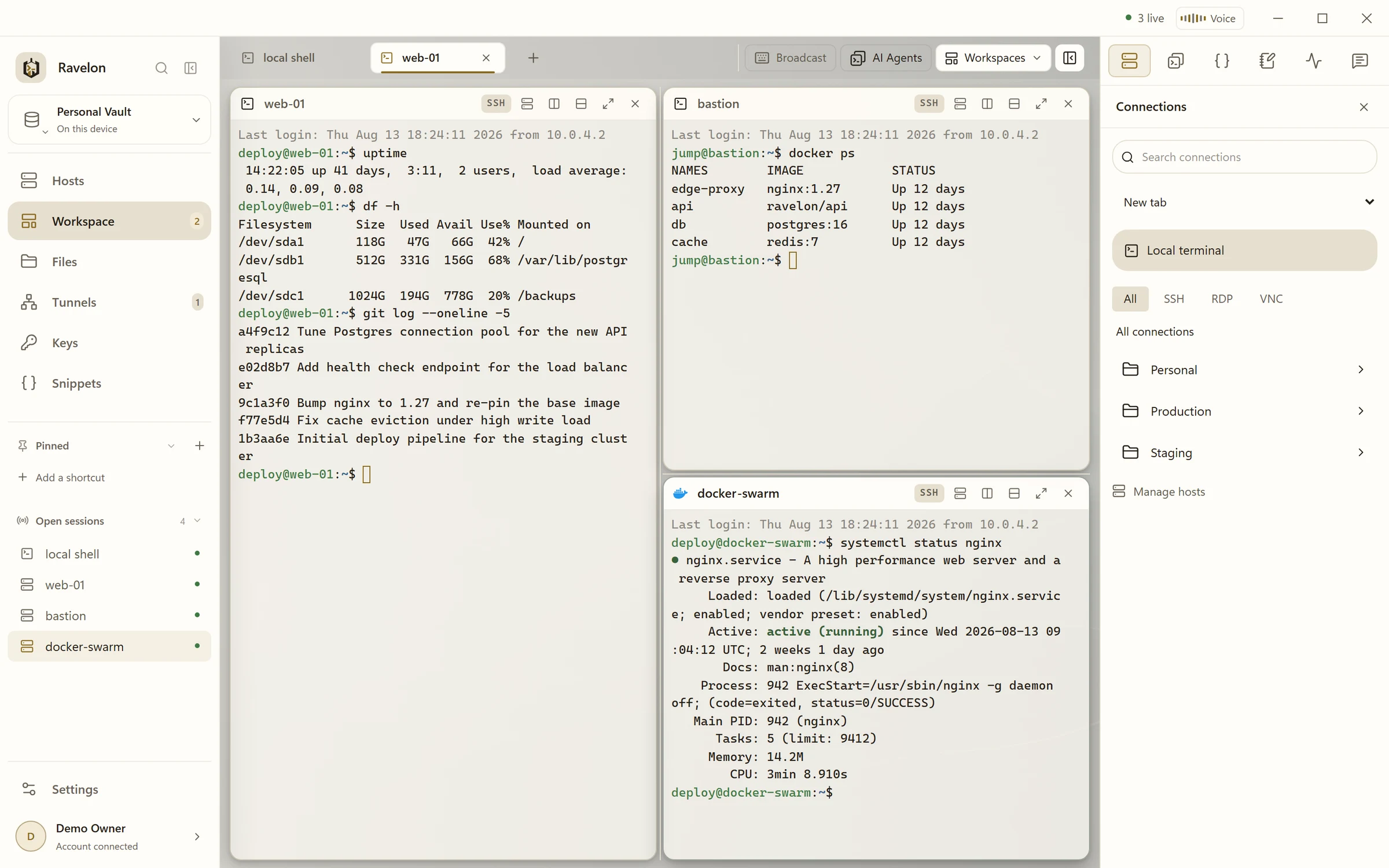
At a glance
- Protocols
- SSH, SFTP, RDP, VNC, Telnet and serial console
- Systems
- Windows, macOS and Linux
- Licence
- One-time purchase, no subscription
- Price
- Free without sync, Pro with sync €49.90 once
- Sync
- End-to-end encrypted. We host it, or you do.
Ravelon and mRemoteNG, side by side
| Compared | Ravelon | mRemoteNG |
|---|---|---|
| Pricing | Free without sync. Pro is EUR 49.90 once and adds sync. The self-hosted sync server is free and open source. | Free and open source under the GPL v2. |
| Platforms | Windows, macOS and Linux, on x86_64 and ARM64, with .deb and .rpm packages for Linux. | Windows. |
| Connection types | SSH, SFTP, tunnels, RDP, VNC, Telnet, serial, local shells and coding agents. | RDP, VNC, SSH, Telnet, HTTP and HTTPS, and more. |
| Credentials | Encrypted vault (AES-256-GCM) on your device. Sync only sees encrypted data. | A local connection file, with an optional password to encrypt it. |
| Import and export | Import from OpenSSH config, CSV, PuTTY, MobaXterm, Royal TS and Termius; export as JSON, CSV or OpenSSH config. | XML and CSV files, plus import from Active Directory and a port scan. |
mRemoteNG column last checked: 2026-10
Sources for mRemoteNG: mRemoteNG website, mRemoteNG import and export, mRemoteNG on GitHub
Product fit
Ravelon or mRemoteNG?
Stay with mRemoteNG if
- You work only on Windows and want an open-source tool under the GPL.
- You import connections from Active Directory or a port scan.
- Your team keeps the connection list in a shared SQL database.
Ravelon limitations
- The desktop app is proprietary. Only the sync server is open source (MIT).
- The Windows installer is not code-signed yet, so SmartScreen asks once before the first start.
- There is no direct mRemoteNG import. Connections come over as CSV, without passwords, and SSH2 entries need ssh in the Protocol column.
Ravelon features
Four reasons to move from mRemoteNG to Ravelon
01
Windows, macOS and Linux
The same app on all three systems, on x86_64 and ARM64. A host list you build on Windows opens on a Mac or a Linux laptop as it is.
02
Encrypted vault
Hosts, keys and passwords are encrypted with AES-256-GCM on your device. An optional encryption password adds a lock screen and an idle lock.
03
SSH with files and tunnels
Terminal, SFTP browser and saved tunnels share one SSH connection per host. Jump hosts, OpenSSH certificates and pinned host keys are built in.
04
Sync when you want it
The app is free without sync. Pro adds end-to-end encrypted sync through Ravelon Cloud for EUR 49.90 once, or you run the free sync server yourself.
Tabs and split panes
Open RDP, VNC and SSH hosts side by side in one tab, and save the layout as a workspace to bring it back later.
- RDP with TLS and NLA, clipboard sharing and printer redirection
- VNC over verified TLS or through a saved SSH host
- Type into many panes at once, or run one command on many hosts
- Pinned host keys and jump hosts with their own second factor
Encrypted, on every device
Every record is encrypted on your device before it syncs, through Ravelon Cloud or your own server. Team vaults share hosts with owner, admin, editor and viewer roles.
Your host list, the same on every system.
Switching
mRemoteNG migration
Export your connections in mRemoteNG as a CSV file. Ravelon reads the Name, Hostname, Port, Username, Protocol and Description columns; change SSH2 to ssh in the Protocol column and SSH, RDP and VNC entries come over in one go.
Add passwords to the vault once after the import, and put shared users and jump hosts on a group so every host inside inherits them.
Install Ravelon
Download the build for your system from the download page. The local desktop app is free. Pro adds cloud sync and Ravelon ID.
Export a CSV from mRemoteNG
In mRemoteNG, export the connections as CSV. Change SSH2 to ssh in the Protocol column, then choose Hosts > Import in Ravelon.
Add passwords and keys to the vault
Standard file imports leave out passwords. Add them to the vault once. To sync them to your other devices, turn on Sync keys & identities.
Connect once and confirm the host key
The first connection to each server shows its host key fingerprint. Confirm it, and Ravelon pins it and warns you if it ever changes.
FAQ
Frequently asked questions
How do I bring my mRemoteNG connections over?
Export them in mRemoteNG as CSV, change SSH2 to ssh in the Protocol column and choose Hosts > Import in Ravelon. Passwords are left out; add them to the vault afterwards.
Is Ravelon open source like mRemoteNG?
The desktop app is proprietary and free to use without sync. The sync server for self-hosting, Ravelon Sync, is open source under the MIT licence.
Does Ravelon run on Windows?
Yes, on x86_64 and ARM64, with an installer that brings in-app updates. It works the same way on macOS and Linux.
Try it first
Try it on your own servers.
Try the free desktop app with its encrypted vault, SFTP, RDP, VNC and assistant. Import your SSH config and use Ravelon alongside your current client.
Other comparisons
Termius alternative
Free local tools with optional one-time Pro cloud sync.
Warp alternative
Your servers, files and tunnels in one workspace, with AI that waits for your OK.
PuTTY alternative
Your PuTTY sessions in one window, with a vault and a file browser.
MobaXterm alternative
The session-plus-files workflow you know, on macOS and Linux too.
Tabby alternative
Vault, files, tunnels and sync in one app, ready from first launch.
SecureCRT alternative
Free local connections with optional one-time Pro cloud sync.
Termix alternative
A native desktop app with a local vault, ready to go without any server setup.
Royal TS alternative
SSH first, with RDP and VNC alongside, on Linux too.
Remmina alternative
RDP and VNC right next to your SSH work, on Windows and macOS too.
Remote Desktop Manager alternative
RDP, VNC and SSH in one window, free locally and Pro paid once.
RealVNC alternative
VNC next to SSH and RDP, over verified TLS or an SSH tunnel.
Conductor alternative
Parallel coding agents in worktrees, on Windows, macOS and Linux.